
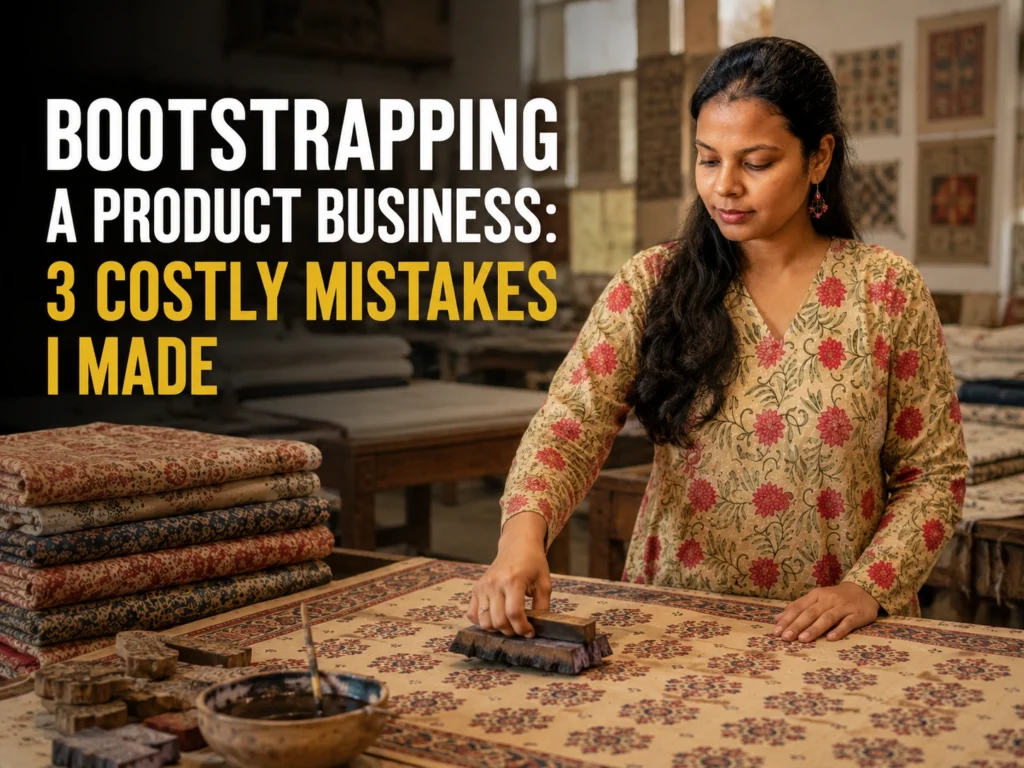
Bootstrapping a Product Business: 3 Costly Mistakes I Made (And How to Avoid Them)
If you spend enough time on LinkedIn or Instagram, bootstrapping a business looks incredibly romantic. Scrolling through feeds, you see beautiful product launches, aesthetic office setups, and celebratory “sold out” posts. What remains hidden is the expensive, messy reality happening behind the scenes.
When I started SA Fab, I funded the company entirely on my own. Bootstrapping meant every single spent rupee came straight from my pocket. Investors offer a cushion of capital to fall back on if an experiment fails, but I had none. Because of that reality, my mistakes didn’t just hurt my ego—they directly impacted my cash flow.
Today, SA Fab operates as a thriving D2C brand working with over 200 artisan families in Rajasthan. Getting to this point required me to pay the “tuition fee” of entrepreneurship. If you are currently building a product business, read about three costly mistakes I made early on, and exactly how you can avoid them.
Mistake 1: Falling for the “High MOQ” Trap (Over-ordering Inventory)
In the early days, I believed I needed a massive, diverse product catalog for customers to take my fashion brand seriously. Factories and suppliers usually demand high Minimum Order Quantities (MOQs), pushing founders to buy hundreds of meters of fabric just to get a good price. I fell for this exact trap.
The result? “Dead stock” tied up a huge chunk of my limited capital because those extra products didn’t sell as fast as I anticipated.
The Fix: Test small before you go big. Cash flow acts as your oxygen when bootstrapping. Launching a few highly curated, excellent products and selling out works much better than holding massive inventory. (Note: Making this error actually inspired me to launch our B2B wholesale arm at SA Fab. We now offer authentic Bagru prints to other boutique owners with a tiny MOQ of just 10 meters, ensuring they never repeat my inventory mistakes!)
Mistake 2: Rushing the Sampling Process
Excitement over a new design often makes you want to push it into production and launch immediately. Early on, I underestimated the critical importance of rigorous sampling.
Working with authentic, sun-baked, handblock prints means the fabric behaves differently than commercial synthetic textiles. A design might look perfect on paper but drape differently or require specific stitching adjustments once you wash the natural fabric. By rushing the sampling phase, I created a batch of garments that didn’t meet my strict quality standards. Refusing to sell them meant taking a complete loss on the production cost.
The Fix: Slow down. You simply cannot rush true craftsmanship. Today, our team rigorously wear-tests, washes, and adjusts fittings before we approve any SA Fab piece for mass production. This extra step delays the launch by a few weeks, but it saves thousands of rupees and protects the brand’s reputation.
Mistake 3: Underestimating the Hidden Costs of Logistics
When pricing my first few products, I calculated the cost of the fabric, artisan wages, stitching, and a standard shipping fee. Thinking I had healthy margins felt great at the time. Reality proved me wrong very quickly. E-commerce logistics carry hidden costs that I completely forgot to factor in, such as premium packaging materials, RTO (Return to Origin) fees, exchange shipping, and payment gateway charges.
By the end of the month, those hidden logistics ate my “healthy margin” alive.
The Fix: Map out the entire lifecycle of a product, tracking its journey from the moment it leaves your warehouse to the moment it safely reaches the customer’s closet. Factor a 10-15% buffer for returns and exchanges into your core pricing model from Day 1.
Mistakes Are Just Data
A costly error can feel like the end of the world when you bootstrap a brand. Over time, however, I have learned to view these mistakes simply as data. They highlight the cracks in your foundation so you can fix them before scaling up.
Entrepreneurs do not need to have all the answers to start a business. Resilience to survive those inevitable mistakes and humility to learn from them will carry you all the way.
Are you currently bootstrapping a brand? What is the biggest lesson your mistakes have taught you so far? Let’s connect in the comments below!